
Why Governance, Systems, and Information Security Connections Matter
Connecting the Information Security dots.
Organisations often talk about governance, systems, and information security as separate topics.
In practice, they are closely connected — and when they aren’t aligned, risk increases.
The governance–systems–information security diagram is important because it makes these relationships visible and helps leaders understand where weaknesses usually appear.
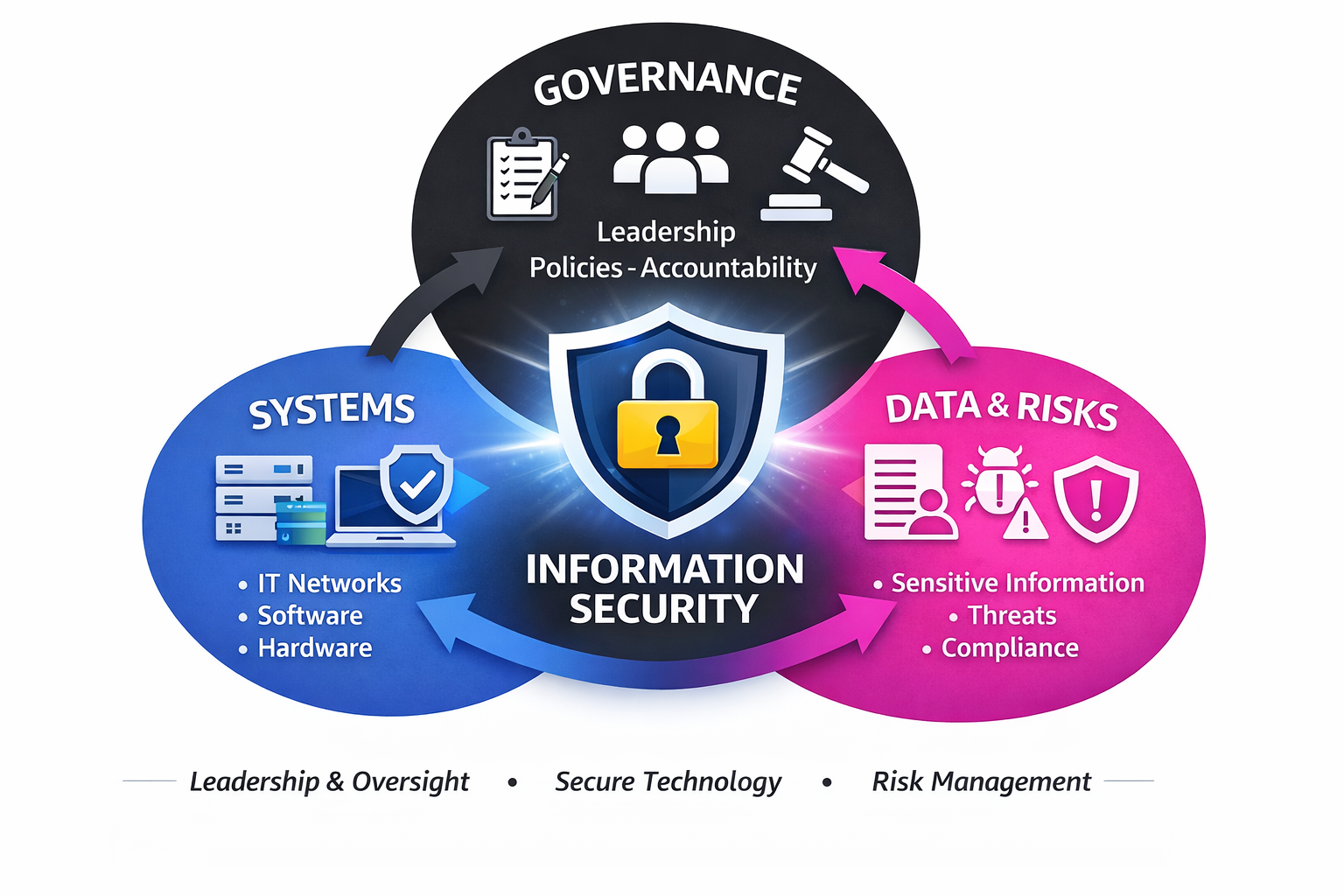
Diagram showing the connection between governance, systems and information security.
Governance: setting direction and accountability
At the top of the diagram is governance. This represents leadership, oversight, and accountability. Governance is where expectations are set and where responsibility ultimately sits.
Strong governance provides:
Clear ownership of risk and decision-making
Defined expectations around data protection and security
Oversight of whether controls are working in practice
Confidence for boards, trustees, and senior leaders
Without effective governance:
Policies exist but are not enforced
Risks appear on registers but are not actively managed
Information security becomes fragmented and reactive
The diagram reinforces a key message: information security starts with leadership, not technology.
Systems and processes: turning intent into action
Between governance and information security sit systems and processes. These are the mechanisms that translate leadership intent into day-to-day behaviour.
Good systems:
Make the right behaviours easy and repeatable
Reduce reliance on individual knowledge or workarounds
Create consistency across teams and locations
Provide evidence that controls are operating
When systems are weak or unclear:
Staff invent their own ways of working
Controls are applied inconsistently
Risks increase without being obvious
The diagram shows that systems are the bridge between governance and operational reality.
Without this bridge, even good leadership decisions fail to deliver results.
Information security, data, and risk: protecting what matters
Information security is often seen as a technical issue, but it is really about risk and impact.
This part of the diagram focuses on understanding and protecting the information that matters most.
Effective information security means:
Knowing what data you hold and why
Controlling who can access it
Reducing the risk of loss, misuse, or disruption
Being able to respond when something goes wrong
When organisations focus only on tools:
Controls are implemented without context
Assurance is hard to demonstrate
Cyber incidents come as a surprise
The diagram makes it clear that information security is strongest when it is supported by systems and driven by governance.
Why the connection matters
The real value of the diagram is that it shows what happens when one element is missing:
Governance without systems → good intentions, poor execution
Systems without governance → activity without accountability
Security without either → unnecessary and unmanaged risk
For businesses, charities, and regulated organisations, this connection is increasingly important.
Funders, regulators, auditors, and customers now expect evidence, not reassurance.
In short, the diagram helps organisations move from awareness to assurance by showing that good information security depends on governance, systems, and risk working together — not in isolation.
